Recovery Point Objective (RPO) is the maximum allowable data loss window (measured in time) a business can tolerate after a disruption, while Recovery Time Objective (RTO) is the maximum downtime allowed to recover systems and resume normal operations.
In other words, RPO defines how much recent data you’re willing to lose (e.g. minutes or hours since the last backup) and RTO defines how quickly you must restore service (e.g. hours or minutes of outage).
Recovery Point Objective (RPO)
Recovery Point Objective (RPO) focuses on data loss. It answers the question: “How much recent data can we afford to lose?”
RPO is usually expressed as a time (e.g. minutes or hours) between the last backup/checkpoint and the failure.
A shorter RPO means less data loss but requires more frequent backups or real-time replication .
For example, an RPO of 15 minutes means that the system should be backed up every 15 minutes, so at most 15 minutes of data are lost if a crash occurs.
-
Data Currency: RPO is measured in time and defines how recent the restored data must be.
-
Backup Frequency: Shorter RPO (less data loss) requires more frequent backups or continuous replication.
-
Analogy: Think of RPO like autosave in a document editor. If you save every 5 minutes (RPO = 5 min), you can only lose 5 minutes of work if the program crashes.
Maintaining a low RPO (near zero) usually means using synchronous mirroring or very frequent snapshots, which can be costly.
Organizations choose RPOs based on how critical each system’s data is: e.g. an online trading platform might require RPO = 1 min, whereas a rarely-changed archival database might tolerate RPO = 24 hours.
Recovery Time Objective (RTO)
Recovery Time Objective (RTO) focuses on downtime. It answers: “How quickly must we recover?”
RTO is the maximum acceptable time that a service can be offline after an incident.
In other words, it is the target time window to bring systems back to operation following a failure.
A shorter RTO means systems must be restored faster, which often requires robust high-availability infrastructure or automated failover.
-
Downtime Window: RTO is measured in time and defines how long services can be down.
-
Recovery Planning: Shorter RTO requires faster restoration methods (e.g. automated failover, hot standby servers) to meet the deadline.
-
Practical Example: If RTO = 2 hours and a server fails at 3:00 PM, it must be running again by 5:00 PM.
Meeting an aggressive RTO often means higher costs (extra hardware, replication, 24/7 support).
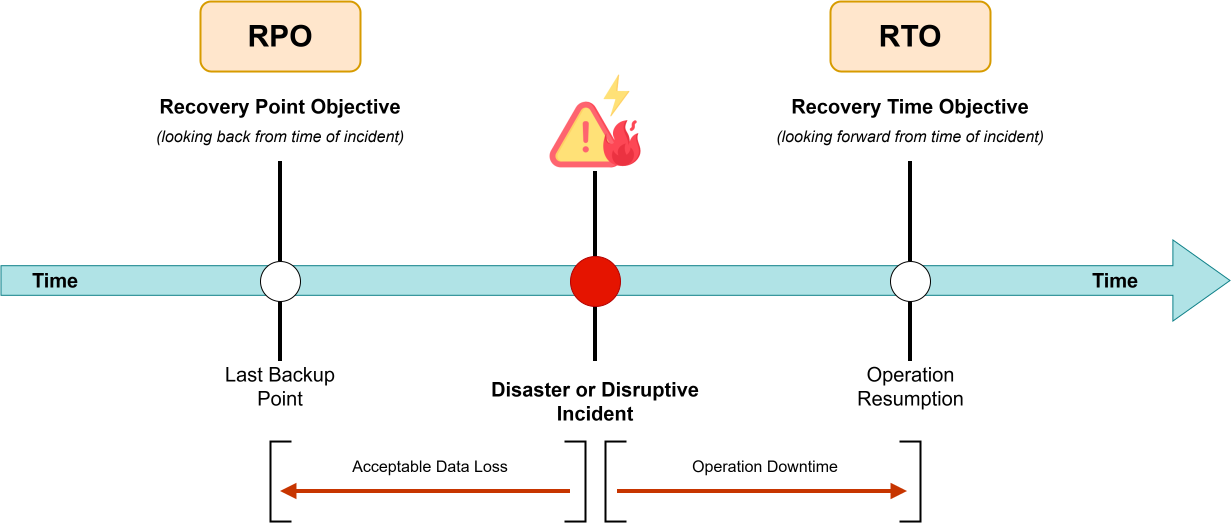 Image scaled to 95%
RPO vs RTO: Key Differences
Although RPO and RTO are both measured in time, they focus on different aspects of recovery: RPO is about data loss tolerance, RTO is about downtime tolerance.
In summary:
-
Scope: RPO deals with the maximum amount of data loss (time) the business can absorb. RTO deals with the maximum downtime (time) allowed before systems are restored.
-
Question: RPO answers “How much recent data can we afford to lose?”; RTO answers “How quickly must we recover to normal operations?”.
-
Planning: RPO drives backup/replication schedules; RTO drives recovery procedures and failover plans.
-
Cost Trade-off: A very low RPO (e.g. near zero) needs frequent backups or continuous sync, raising storage and bandwidth costs. A very short RTO requires extra investment in redundancy (hot spares, clustered servers) to recover quickly.
-
Interplay: You can meet one and not the other. For example, you might restore systems quickly (meeting RTO) but from an old backup (missing the RPO); or have all data up-to-date but take longer to bring systems online.
In practice, organizations choose RPO and RTO together based on risk tolerance and budget.
Critical services often require both low RPO and low RTO, which drives investment in high-availability architectures and continuous data protection.
Less critical systems might accept longer RPO/RTO to save costs.
Importance in Disaster Recovery Planning
RPO and RTO are fundamental to any disaster recovery (DR) or business continuity plan. They become concrete recovery SLAs (service-level agreements) that guide design decisions.
Clear RPO/RTO targets ensure everyone knows the priorities.
For example, mission-critical applications might need RPO = 5 min and RTO = 30 min, while a test lab might allow RPO = 24 h and RTO = 12 h.
Setting these objectives helps allocate resources – for instance, deciding how often to back up data and whether to use hot standby servers.
Importantly, missing RPO/RTO targets can be very costly.
Every minute of downtime can lead to lost revenue or reputational damage. Studies show that downtime can cost businesses hundreds of thousands of dollars per hour.
Likewise, losing critical data can lead to compliance penalties or customer churn.
Thus, disaster recovery planning involves balancing the cost of meeting stricter RPO/RTO against the potential impact of data loss or downtime.
-
Business Continuity: RPO/RTO targets ensure critical systems and data are prioritized so the business can continue.
-
SLA Commitments: They often appear in SLAs or regulatory requirements, defining guaranteed recovery levels.
-
Resource Planning: By knowing the RPO and RTO goals, IT can budget for the necessary backup, replication, and recovery infrastructure.
Practical Examples
-
Example: A retail website sets RPO = 30 minutes and RTO = 2 hours. If the last database backup was at 10:00 AM and the system crashes at 12:15 PM, up to 30 minutes of new orders (from 11:45–12:15) could be lost. The recovery team must have the site fully online by 2:15 PM (2 hours after 12:15) to meet RTO.
-
Scenario: A bank might tolerate RPO = 10 minutes for its transaction database (to avoid losing orders) and RTO = 10 minutes for its customer-facing app. In one real example, a bank had RPO = 15 min and RTO = 10 min during a morning outage and successfully recovered in 5 min, meeting both goals.
These examples show how RPO and RTO translate into concrete actions (backup schedules, failover processes) and deadlines.
They are common interview topics for system architects and DevOps engineers, so be prepared to explain that RPO is about “time behind data” and RTO is “time to get back up” in your own words.