An error budget is the allowable amount of downtime or failures a service can tolerate within a given period without breaking its reliability targets, essentially acting as a buffer that balances system reliability and the pace of innovation.
In practice, an error budget is defined based on a service’s reliability goals (often expressed as a Service Level Objective, or SLO). It’s essentially 100% minus the SLO.
For example, if a service has an SLO of 99.9% uptime, the remaining 0.1% is the error budget (about 43 minutes of downtime allowed per month in this case).
This concept comes from Site Reliability Engineering (SRE) and is used to ensure teams acknowledge that a small amount of failure is acceptable and expected, so they can push new releases without aiming for impossible 100% uptime.
Understanding Error Budgets
No complex system can be perfect, and striving for 100% uptime indefinitely is usually impractical.
Error budgets embrace this reality by quantifying how much “unreliability” or acceptable downtime is allowed.
In other words, the error budget is a target for how much a service can fail before users or business are impacted beyond acceptable limits.
This serves as a safety margin for the team: as long as the errors or downtime stay within this budget, the service is considered to be within its reliability goals (meeting its SLO).
Once the budget is exhausted (i.e. too much downtime or too many errors have occurred), the service is no longer meeting the agreed reliability target.
In SRE and DevOps practices , error budgets are a cornerstone for balancing rapid innovation with stability. They let product teams and operations teams have a common gauge of service health that informs decision-making.
The error budget provides a clear, objective metric of how unreliable the service is allowed to be in a given period.
This prevents debates and guesswork, for instance, instead of endless arguments between engineers wanting to release new features and those worried about reliability, the error budget data “removes the politics” by showing plainly whether there is room for more risk or not.
How Is An Error Budget Calculated?
Typically, you derive it directly from the SLO.
If your SLO is 99% uptime, that means you’re permitting 1% downtime as the error budget. In a month (~43,200 minutes), 1% downtime equals 432 minutes allowable downtime.
If the SLO is 99.9%, the error budget is 0.1% (about 43 minutes per month, as noted above). These calculations give teams a tangible number of minutes or error events they can “afford” in terms of failures. It’s essentially a risk quota.
As long as the quota isn’t fully spent, you are within acceptable reliability limits.
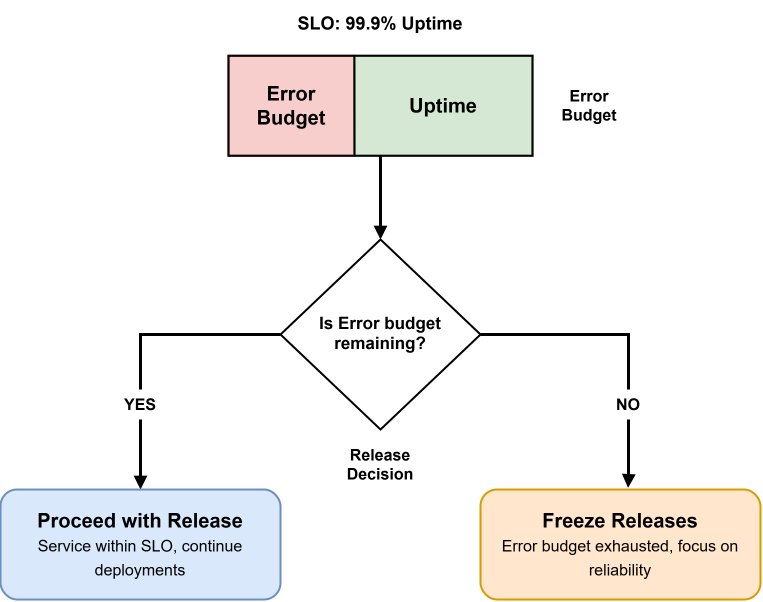 Image scaled to 75%
Error budgets are important because they help balance competing priorities in software development and IT operations.
Here are a few key reasons an error budget is so valuable:
-
Balancing Reliability and Innovation: An error budget provides a clear threshold of unreliability that’s acceptable, allowing teams to balance the need for system stability with the push for new features and improvements. It prevents an excessive focus on 100% uptime (which can slow down development) by explicitly permitting a small amount of failure. This way, teams can innovate quickly as long as reliability stays within agreed limits.
-
Data-Driven Decision Making: Error budgets offer a data-driven framework for making decisions about releases and changes. Because the budget is quantified (e.g. X minutes of downtime or Y errors left this month), teams can use it to objectively decide whether it’s safe to deploy a new release. If plenty of budget remains, riskier changes might be acceptable; if the budget is nearly used up, it’s a signal to hold off on risky updates. In short, the error budget acts as a go/no-go metric for release decisions.
-
Accountability and Focus: By setting a clear limit on unreliability, error budgets create accountability. Engineering teams know the exact boundary not to cross, which encourages them to prioritize reliability work appropriately. If the service has been unstable and is close to breaching the SLO (using up the error budget), everyone understands that improving stability is the top priority. This shared accountability helps maintain user satisfaction.
-
Team Alignment and Collaboration: Error budgets foster collaboration between development and SRE/Ops teams by aligning their goals. Both teams have a shared objective: keep the service reliable enough to stay within the error budget. This shared metric means product development and reliability engineers are on the same page about how much risk is acceptable. It turns reliability into a shared responsibility rather than a point of tension. As a result, discussions about pushing new features versus fixing bugs become easier to resolve. The error budget guides what to do next.
How Error Budgets Guide Release Decisions
One of the most practical uses of an error budget is guiding release management, deciding when to launch new versions or features of a service.
Essentially, the error budget is used as a control knob for release velocity:
-
If the error budget has room to spare (service within SLO): The team has not exhausted the allowable failure quota, so from a reliability standpoint, it’s safe to continue releasing new features or changes. When reliability is better than the minimum target, you can afford to take some risks and move fast with deployments. In Google’s SRE practice, for example, as long as the measured uptime is above the SLO (i.e. error budget remaining), “new releases can be pushed” as normal. A healthy error budget essentially green-lights development to proceed at the usual (or even accelerated) pace.
-
If the error budget is nearly exhausted (approaching SLO limits): This is a warning sign that the system had several issues recently and is close to breaching its reliability target. It’s a signal to slow down and exercise caution. Teams might decide to postpone low-priority releases, add extra testing, or use safer deployment strategies (like canary releases) to mitigate risk. In other words, when the budget is low, the bias shifts toward stabilizing the system rather than adding new changes. Product managers and developers, seeing the slim budget left, will often self-impose more rigorous testing or fewer pushes because they know another incident could use up the budget and trigger a freeze.
-
If the error budget is completely spent (SLO violated): This means the service has exceeded its acceptable failure allowance for the period, essentially, reliability has dropped below the agreed target. At this point, the guideline is usually to halt all non-essential releases until the system recovers and reliability is back on track. For example, a team might institute an emergency freeze on deployments: no new features or changes go out until enough time passes without incidents (or fixes are made) such that the service is within SLO again. During this time, effort is redirected to improving stability, fixing bugs, scaling infrastructure, or whatever is needed to reduce errors. Only urgent patches (like critical security fixes or major bug fixes) would be allowed. This policy protects users from further instability and directs the team’s energy toward raising reliability before any more innovation. In summary, when the error budget is exhausted, reliability work trumps feature work until the budget is back in the green.
This approach to releases can be thought of as a stoplight model: green means budget available -> proceed with releases; yellow means budget low -> careful with releases; red means budget gone -> stop releases.
Many SRE teams implement formal “error budget policies” that codify these rules for their services.
The result is a feedback loop where the current reliability state of the service (as indicated by error budget consumption) directly influences how aggressive or conservative the team is in pushing updates.
By doing so, teams ensure that they don’t keep piling changes onto an already shaky system, and conversely, they don’t needlessly hold back innovation when the system is performing well within limits.
Example: Using an Error Budget in a Release Decision
Scenario: Imagine a video streaming platform with a monthly uptime SLO of 99.5%. This means the service is allowed up to 0.5% downtime each month as its error budget.
In a 30-day month (43,200 minutes), 0.5% downtime is about 216 minutes of allowable downtime.
Now, suppose early in the month the platform experiences an outage due to a bug, lasting 120 minutes.
That incident uses over 50% of the monthly error budget in one go. As a result, the team now only has ~96 minutes of downtime left for the rest of the month to stay within SLO.
Seeing this, the platform’s SRE and development teams make some decisions:
-
They delay a planned feature release that was considered risky, because another serious outage could easily burn through the remaining error budget and cause an SLO miss.
-
The engineers focus on investigating and fixing the root cause of the 120-minute outage. They also audit recent changes to catch any other issues that could affect stability.
-
The product manager communicates to stakeholders that new feature rollouts will be slower this month, prioritizing reliability. This is an agreed trade-off to ensure user trust isn’t compromised by further downtime.
Later in the month, with no additional major incidents, the service stays within its error budget.
By the start of the next month, the error budget resets (as SLOs are typically measured per month or quarter).
The team, having improved the system and with a fresh error budget, resumes their regular release tempo for new features, now with confidence that they can do so without immediately violating reliability targets.
In this scenario, the error budget clearly guided the release decisions.
When the budget was more than half consumed, it signaled the team to shift gears toward stability.
Once the new period began (and reliability was back to acceptable levels), it signaled that normal development speed could resume.
This example shows how even junior developers and product owners can use the error budget as a simple yardstick: if the reliability margin is slim, slow down; if it’s healthy, you can move faster.
Analogies to Understand Error Budgets
For a non-technical analogy, consider a restaurant that promises fast service.
Let’s say the restaurant’s goal is to serve every customer within 20 minutes (their equivalent of an SLO).
However, they know things won’t always go perfectly; occasionally, orders might be delayed.
Suppose the manager decides that as long as 95% of orders are on time, they’re meeting the promise.
That means they allow 5% of orders to be late without hurting the overall customer experience. That 5% is like the restaurant’s error budget for delays.
If on a given day they’ve already had too many late orders (using up that 5% allowance), the manager might stop taking new reservations or give the kitchen a breather to catch up (analogous to halting new releases) so that no more customers are disappointed.
This parallels how, in software, teams use error budgets: a certain small fraction of failure is permitted, but once you exceed that allowance, you must pause and focus on quality of service before taking on more load or features.
Another everyday analogy is a personal budget: Imagine you have a monthly budget for entertainment.
If you spend too much early in the month, you know to cut back later to avoid running out of money.
Similarly, an engineering team “spends” its error budget when incidents occur; if they spend it too fast, they must cut back on risky changes to avoid overshooting their reliability target.
These analogies underscore the concept that an error budget is about tolerance and trade-offs. It’s a management tool to ensure you don’t overspend your allowance of unreliability.
By thinking of reliability in terms of a budget, even non-technical stakeholders can understand that it’s about making smart choices: sometimes you can “afford” to take a risk, and other times you need to tighten up and stabilize.
Conclusion
An error budget is a powerful but simple tool for maintaining the right balance between moving fast and staying reliable.
By quantifying how much failure is acceptable, it provides clear guidance on when a team should accelerate and launch new features versus when they should pause and harden the system.
For beginners and aspiring SREs or DevOps engineers, understanding error budgets is crucial. It teaches that reliability isn’t about zero errors, but about managing risk within limits.
Above all, using an error budget to guide release decisions leads to data-informed, transparent decision-making that aligns everyone (developers, SREs, product managers) toward the shared goal of happy users and a stable, evolving service.
When preparing for interviews or new projects, remember this key point: an error budget is not just a metric, it’s a policy that tells you when to innovate and when to stabilize, ensuring you deliver features at a pace that your system (and your users) can safely handle.