Circuit breakers stop repeated calls to a failing service after a failure threshold is met, retry with exponential backoff automatically re-attempts failed operations with progressively longer waits, and rate limiting caps the number of requests per time unit to prevent overload.
What Is a Circuit Breaker?
A circuit breaker is a protection mechanism inspired by electrical circuits.
When a service or resource fails repeatedly, the circuit breaker “opens” and immediately rejects further calls instead of letting each request time out or fail.
By opening the circuit after a configurable number of failures (e.g. 5 errors in a row), the system avoids wasting resources on an already-broken service.
After a cool-down period the breaker moves to a half-open state to test the service again, and if calls succeed it closes the circuit back to normal operation.
This stateful pattern helps prevent cascading failures: for example, if a downstream API is down, the circuit breaker trips and your system can fall back quickly rather than slowing down or crashing.
Key points:
-
Circuit breakers monitor failures. When the error rate is too high, they open and immediately reject calls.
-
In the Closed state, calls pass through normally; in Open, calls fail fast; in Half-Open, a few test calls are allowed to check recovery.
-
Common use cases include protecting microservices or external API calls. For instance, if a payment service fails, a circuit breaker will quickly halt calls and invoke a fallback response.
What Is Retry with Exponential Backoff?
Retry with backoff is a strategy for handling transient failures (temporary glitches).
Instead of failing on the first error, the system retries the operation a few times, waiting longer between each attempt (often doubling the wait each time, known as exponential backoff).
For example, if an HTTP request to a service fails due to a brief network hiccup, the client might retry after 1s, then 2s, then 4s.
Exponential backoff helps avoid immediately re-overloading the service and spreads out retry attempts across time.
This pattern is stateless (each retry is independent) and assumes errors are short-lived.
Key points:
-
Transient faults: Use retry when failures are likely temporary (e.g. brief network outage, a busy server). You give the system a chance to recover on its own.
-
Backoff delays: Each retry waits longer than the last (e.g. 1s, 2s, 4s…). Many implementations add a random “jitter” so that many clients don’t retry in lockstep.
-
Retry limits: You set a maximum number of retries to avoid endless loops. After that, you assume the fault isn’t transient. A fallback or error is then returned.
What Is Rate Limiting?
Rate limiting (or throttling) controls traffic by putting an upper bound on requests per time unit. It is not triggered by failures at all but by sheer request volume.
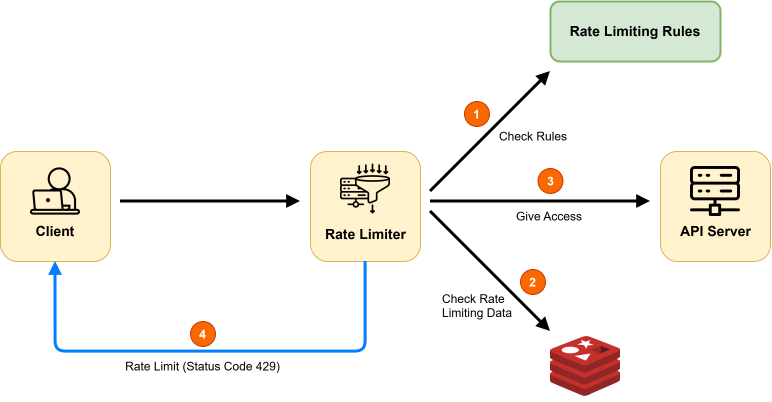 Image scaled to 75%
For example, an API might allow only 100 calls per minute per user.
Once the limit is reached, further calls are paused or rejected until the next time window. This ensures fair use and protects the service from overload or abuse.
Rate limiting is a standard practice in public APIs, login attempts (to prevent brute-force attacks), and any high-throughput system.
Key points:
-
Traffic control: Rate limiting enforces a fixed capacity (e.g. 10 requests/sec) to keep systems responsive.
-
Algorithms: Common methods include token buckets or leaky buckets, which smooth bursts of traffic into allowed rates.
-
Typical uses: API gateways , web servers, and messaging systems use rate limiting to prevent spikes and ensure stability. For example, cloud services often return HTTP 429 “Too Many Requests” when a client exceeds its allotted rate.
Differences and When to Use Which
-
Trigger: Circuit breakers react to failures (error rates), retry-with-backoff reacts to errors/timeouts by retrying, and rate limiting reacts to high request volume.
-
Purpose: Circuit breakers fail fast to protect the system during persistent problems. Retry-with-backoff keeps trying to overcome fleeting issues. Rate limiting prevents overload upfront by capping throughput.
-
State: Circuit breakers are stateful (they track recent failures and have Closed/Open/Half-Open states). Retries are stateless retries (each attempt is separate). Rate limiting may be stateful (tracking counts in time) but is not based on failures, only counters.
-
Best for: Use retry when errors are likely transient (e.g. a brief network glitch). Use circuit breaker when errors may be persistent (e.g. a down service) to avoid wasting resources. Use rate limiting to protect against excessive load or abuse by limiting calls per second/minute.
Example scenarios:
-
A web microservice calls an external API. If the API sometimes fails with a 502, the client can retry after a short delay with backoff. If the API keeps failing, a circuit breaker opens and prevents further calls, returning a cached or default response. Separately, the client’s calls to the API are also throttled to 50 QPS by a rate limiter, so even if the API is healthy, it cannot be overloaded.
-
For login attempts, a rate limiter prevents brute-force (e.g. max 5 logins per minute). If a login service is temporarily down, a retry mechanism might try again after a few seconds. If many logins start failing repeatedly, a circuit breaker could trip to prevent further load on that service.
In summary, retry (with backoff) and circuit breaker are complementary resilience patterns: retries assume faults will clear soon, whereas circuit breakers assume a fault may last long and proactively stop calls.
Rate limiting is about controlling request volume rather than handling failures. By using the right strategy (or combination) in context, systems stay more robust and maintain performance.