A replay attack is a type of cyberattack where an attacker intercepts a valid data transmission and maliciously reuses (repeats or delays) it to fraudulently repeat an action or gain unauthorized access.
In other words, the attacker “plays back” a previously sent message (such as a login token or a payment request) to trick a system into thinking it’s a new, legitimate request.
This concept is distinct from idempotency issues, which refer to problems that occur when a system processes the same request or action multiple times due to design flaws (not necessarily maliciously), leading to unintended duplicate effects.
Below, we’ll break down what replay attacks are, why they matter, and how they differ from idempotency issues in software design.
What Is a Replay Attack?
A replay attack (also known as a playback attack) is a security breach where a hacker intercepts a legitimate message or transaction and then resends it unaltered to replicate its effect.
Because the data is a valid transmission (often already authenticated or encrypted), the system can be fooled into accepting it again.
This kind of attack is a subset of man-in-the-middle techniques and exploits the fact that the system cannot distinguish the replayed message from an original request.
-
How it works: An attacker eavesdrops on communication between a client and server, captures a message (for example, a login credential or a bank transfer request), and later sends the exact same data to the server. The server, thinking it’s a normal second request, performs the action again. The attacker doesn’t need to decrypt or understand the message; simply resending the captured packet can be enough to cause the action to repeat.
-
Importance in security: Replay attacks can lead to serious consequences. For instance, an attacker could replay a payment transaction or money transfer request, causing duplicate charges or unauthorized withdrawals from an account. In an authentication scenario, an attacker might capture an encrypted password hash or authentication token and resend it to impersonate a user (as illustrated in the classic Alice, Bob, and Eve scenario). In that example, Alice sends her hashed password to Bob (the server) to log in, and Eve (an eavesdropper) captures the hash. Later, Eve replays the same hash to Bob, who accepts it and grants access, thinking Eve is Alice.
-
Common targets: Replay attacks are often discussed in the context of network security and cryptographic protocols. They target systems where messages lack freshness indicators (like timestamps or one-time tokens). For example, older or naive authentication schemes that don’t use nonces (one-time random numbers) or timestamped tokens are vulnerable. An attacker can replay a login request or transaction if the system doesn’t realize it’s a duplicate.
-
Prevention: To defend against replay attacks, systems implement measures to ensure each request or transaction is unique or only valid once. Techniques include using session IDs, nonces, or timestamps in each request, and rejecting any message that’s outside an expected time window or has been seen before. For instance, a server might require a cryptographic nonce (a random one-time number) in the client’s request and remember it; if it sees the same nonce again, it knows it’s a replay and will ignore it. Another approach is to include a timestamp and only accept requests within a short timeframe, making old messages useless if replayed later. In secure APIs or webhooks, servers may also attach or require signatures and verify them along with a timestamp, so that any replayed message (even if the content is same) is identified as stale or already processed.
Understanding Idempotency and Idempotency Issues
In contrast to replay attacks, idempotency is not an attack but a property or design principle of an operation.
An operation is said to be idempotent if performing it multiple times has the same effect as doing it once.
In practical terms, this means repeating the action doesn’t change the result beyond the first execution.
The classic examples come from HTTP API design: for instance, making a GET request to fetch data is idempotent (no matter how many times you do it, you just retrieve the same data without side effects), or updating a record with PUT is idempotent (sending the same update twice leaves the record in the same final state).
On the other hand, operations like creating a new entry with POST are typically non-idempotent by default, calling them multiple times could create multiple entries (duplicates).
Idempotency Issues
When a system or API does not properly implement idempotency for operations that may be invoked multiple times, you can get unintended side effects such as duplicate actions, charges, or records. These are what we refer to as idempotency issues.
They often manifest when network glitches or user behavior cause the same request to be sent more than once.
For example, imagine a user clicking a “Submit Payment” button twice because the page was slow.
Without idempotency safeguards, the server might process two payment orders, charging the user twice.
In a distributed system, if a client times out and retries a request, a non-idempotent endpoint could perform the action again (e.g. place a duplicate order) since it doesn’t realize the first attempt already succeeded.
Idempotency issues are essentially bugs or design flaws where the system fails to handle repeated messages safely.
Why Idempotency Matters
Idempotency is crucial for building reliable and user-friendly systems, especially for financial transactions and external API calls.
If not addressed, duplicate processing can harm user trust (nobody wants to be double-charged) and lead to data inconsistencies or extra work (like issuing refunds, cleaning up duplicate database entries, etc.).
In distributed systems and APIs, failures and retries are common, and idempotency ensures that reprocessing a request (say, due to a timeout or retry) doesn’t cause unintended side effects like duplicate charges or records.
In short, designing idempotent operations (or handling duplicates explicitly) is a best practice to make systems robust against both user error and network issues.
Examples of Idempotency in Action
Consider a payment API endpoint POST /payments.
By default, calling this twice could result in two separate payments.
To make it idempotent, the API might require an Idempotency-Key (a unique request identifier) in the header.
The server will store the result of the first request associated with that key, and if it ever sees the same key again, it will return the previous result instead of processing it again.
This way, whether the duplicate request is due to a user double-click or a malicious replay, the outcome is only executed once.
Many payment systems (e.g., Stripe) implement this by having clients send a unique key for each transaction attempt, so even if the call is repeated, the backend knows it’s a duplicate and prevents a second charge.
Idempotency keys and similar patterns (like keeping track of processed messages) are common strategies to avoid idempotency issues.
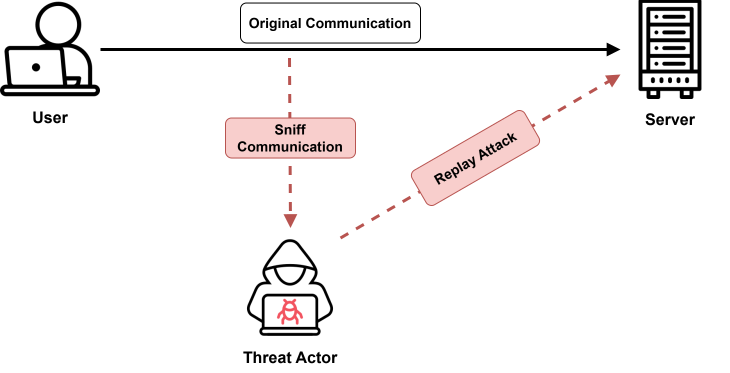 Image scaled to 75%
Replay Attack vs Idempotency Issues: Key Differences
It’s easy to see overlap between replay attacks and idempotent operations since both involve repeated requests, but they refer to different concepts.
Here are the key differences:
-
Nature of the Problem: A replay attack is a security attack. It involves a malicious actor deliberately reusing data to deceive a system. An idempotency issue is a design flaw or scenario in system logic. It happens when the system doesn’t safely handle identical requests happening more than once, often accidentally (e.g., due to retries or user actions). There’s no inherent malice in idempotency issues, though an attacker could exploit a non-idempotent endpoint to amplify an effect (which essentially becomes a replay attack scenario).
-
Context: Replay attacks are discussed in cybersecurity and cryptography contexts, often concerning authentication tokens, network protocols, or transactions where intercepting communications is possible. Idempotency is discussed in software design and API development contexts, ensuring reliability and consistency of operations (especially in REST APIs, webhooks , and distributed systems). For example, webhooks receivers are made idempotent so that if the sender re-sends an event (a common practice or in case of no ACK), the event isn’t processed twice. This is a best practice, not because of an attacker but to handle normal operation retries.
-
Goal/Consequence: The attacker’s goal in a replay attack is typically to gain unauthorized benefit, e.g., get a second service for free, duplicate a payment to themselves, or fraudulently log in as someone else. In contrast, an idempotency issue’s consequence is usually an accidental duplication, e.g., the same action being performed twice when it should have been once, which can cause errors (duplicate data, extra charges) but is often due to oversight rather than an attacker’s intent. The outcome might look similar (two payments instead of one), but the cause is different.
-
Prevention/Mitigation: To prevent replay attacks, the emphasis is on security measures like nonce values, one-time tokens, timestamps, and encrypted signatures to ensure each request is unique and can’t be replayed out of context. On the other hand, to prevent idempotency issues, developers design their APIs and operations to be idempotent or to explicitly handle duplicates, for example, using idempotency keys, checking if an action has already been performed, or making certain operations inherently idempotent (like using
PUTto update orDELETEwhich won’t double-delete). Essentially, replay attack prevention is about keeping attackers from abusing your system, while idempotency is about making your system robust against unintentional repeats (and as a bonus, this robustness also helps if an attacker does try a replay). -
Example Scenario: If a hacker intercepts a fund transfer request on a network and replays it to transfer money again, that’s a replay attack. If a customer unintentionally submits a payment twice due to a page refresh (and the system processes both), that’s an idempotency issue. The first is a deliberate attack vector requiring security responses; the second is a user-experience or design oversight requiring better engineering (though the effects – duplicate payment – might appear similar). Notably, implementing idempotency (say by using unique transaction IDs or keys) can actually mitigate both problems: it will stop the accidental double submission and thwart a would-be replay attacker because the duplicate request (malicious or not) would be recognized and ignored.
Practical Examples and Scenarios
Let’s illustrate the concepts with concrete examples to make them more practical:
-
Replay Attack Example (Duplicate Bank Transaction): Imagine Alice initiates a bank transfer of $100 and the request is sent over the network. Eve, an attacker, sniffs this request (which might be encrypted, but Eve doesn’t need to decrypt it). Eve then waits a minute and resends the same exact message to the bank’s server. If the bank’s system isn’t protected against replays, it might think Alice requested another $100 transfer and execute it. Alice’s account gets debited twice, one legitimately by her, and once by Eve’s replay. Eve could use this trick to, say, pay herself or a collaborator twice from Alice’s account. Solution: The bank should use measures like transaction IDs or nonces (each transfer request must carry a unique one-time ID). If the server sees a reused ID, it rejects the request as a duplicate. Also, including timestamps or requiring fresh user session tokens can ensure old messages can’t be reused after a short period.
-
Idempotency Issue Example (Double Form Submission): Consider an online shopping site where you place an order. You click “Submit Order,” but nothing happens immediately, so you click again. Unknown to you, the first click did go through and was just slow to respond. Without idempotency handling, the server now has two order requests and processes both, creating two identical orders and charging your card twice. This is not a hacker attack, just an unfortunate design issue. Solution: The site’s order API should generate an order ID or expect an idempotency key from the client for each new order intent. If a duplicate request comes in with the same key or same order details, the server recognizes it and does not create a second order, instead returning the result of the first attempt. This way, whether the duplicate was due to a user double-click or a network retry, the outcome is one order. Many services also implement this by disabling the “Submit” button after the first click or showing a spinner, that’s a UI workaround, but at the server side, idempotency keys and request tracking are the robust solution.
How Idempotency Helps Prevent Replay Issues
It’s worth noting the interplay between these concepts: designing for idempotency can limit the damage of a replay attack.
If an attacker tries to replay a request against an idempotent endpoint, the attack is largely ineffective because the system will treat the repeated message as already handled.
In webhook security, for example, it’s recommended to make your handlers idempotent so that if a malicious actor does replay a past webhook event, your system processes it only once and ignores duplicates.
If your endpoints are already idempotent, you won’t be impacted by a replay attack; any repeated message (even if fraudulent) would have no additional effect.
However, pure idempotency is not a substitute for security in all cases; it should complement other measures.
An attacker could still abuse a non-authenticated idempotent endpoint in other ways, and idempotency doesn’t stop an attacker from attempting the replay. It just prevents harmful side-effects.
Therefore, both security tactics (to stop malicious replays) and idempotent design (to handle repeats safely) are important.
Conclusion
In summary, a replay attack is a malicious tactic where valid communications are fraudulently repeated to exploit a system, whereas idempotency issues are unintentional problems arising from performing the same action multiple times in systems that aren’t designed to handle it.
The former is addressed with security measures (ensuring each request is unique or time-bound), and the latter is addressed with sound engineering practices (making operations idempotent or using unique request identifiers).
Understanding both is important for software engineers: replay attacks remind us why protocols need freshness and security, and idempotency principles remind us how to build resilient APIs and systems that behave correctly even when messages are repeated.
By implementing proper safeguards (like nonces, tokens, and idempotency keys), we can mitigate replay attack risks and eliminate duplicate-processing issues, leading to systems that are both secure and reliable in the face of repeated actions.