Document-oriented databases are a type of NoSQL database designed to store, retrieve, and manage semi-structured data as documents. Instead of relying on rigid schemas like traditional relational databases, they use a flexible structure where each document is self-contained and can have varying fields. These databases are especially useful for applications where data structures evolve over time.
In this lesson, we will explore how document-oriented databases work, their key features, popular systems, and real-world use cases.
How Document-Oriented Databases Work
In a document-oriented database, data is stored as documents, typically in formats like JSON or BSON. These documents are grouped into collections, and multiple collections make up a database. Each document has a unique identifier (often called _id) and can contain various fields, arrays, or nested structures.
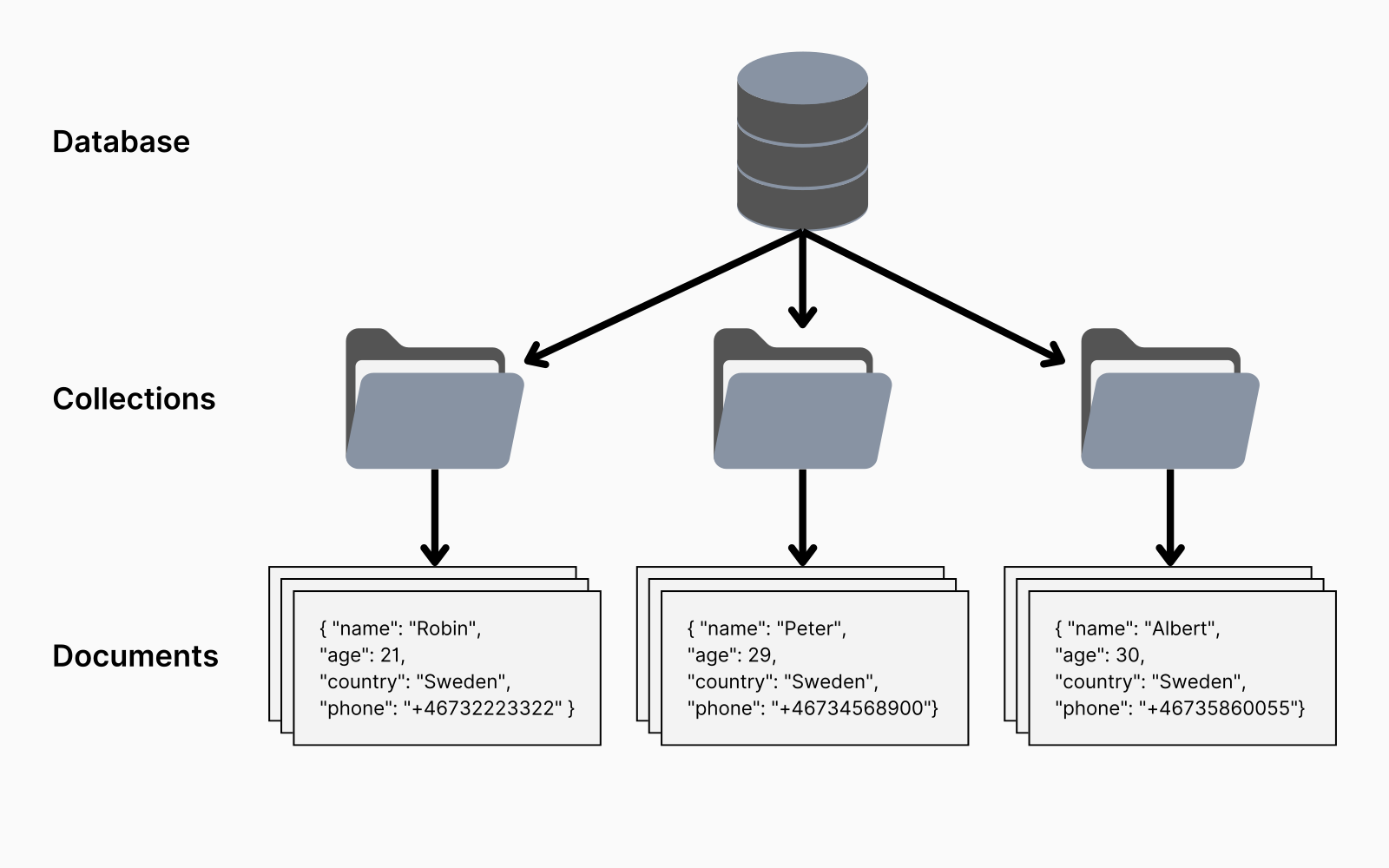 Image scaled to 90%
The attached diagram provides a clear view of the structure:
- The Database serves as the top-level container.
- Inside the database, data is grouped into Collections, which are like folders.
- Each collection contains Documents, which hold the actual data.
For example:
- Document 1:
{ "name": "Robin", "age": 21, "country": "Sweden", "phone": "+46732223322" } - Document 2:
{ "name": "Peter", "age": 29, "country": "Sweden", "phone": "+46734568900" }
This flexible structure allows each document to have different fields if needed, unlike rows in relational databases that must follow a strict schema.
Key Features of Document-Oriented Databases
1. Flexible Schema
- No fixed schema is required. Documents can have different fields, making it easy to store diverse data types.
- Example: A product catalog can store various types of products, each with unique attributes, in the same collection.
2. Nested Data Structures
- Documents can include nested arrays or objects, supporting complex data relationships within a single record.
- Example: A document representing a customer can include an embedded array of order history.
3. High Performance
- Designed for fast reads and writes, document-oriented databases eliminate the need for expensive joins.
4. Scalability
- Horizontal scaling is supported, meaning the database can expand by adding more servers to handle larger datasets.
Popular Document-Oriented Databases
1. MongoDB
MongoDB is one of the most popular document-oriented databases. It stores data in BSON (binary JSON) format and supports powerful querying and indexing.
- Features:
- Flexible and schema-less.
- Supports aggregation pipelines for data analytics.
- Horizontal scaling with sharding.
2. CouchDB
CouchDB is a document database that emphasizes data replication and synchronization.
- Features:
- Uses JSON to store data.
- Built-in support for data replication across distributed environments.
- RESTful API for interacting with the database.
Use Cases of Document-Oriented Databases
1. Content Management Systems
- Content like blog posts, articles, and media files often have varied attributes. Document databases provide the flexibility to store such content efficiently.
Example:
- A CMS uses MongoDB to manage blog posts, where each post contains fields for title, content, tags, and metadata.
2. Product Catalogs
- E-commerce platforms often deal with products that have different specifications, making a document-oriented approach ideal.
Example:
- A product catalog in MongoDB can store electronics with fields like
warrantyandbrand, while clothing items includesizeandmaterial.
3. Real-Time Analytics
- Document databases can handle large-scale, real-time data ingestion and analysis.
Example:
- A gaming application uses MongoDB to log player actions in real-time for leaderboards and insights.
Performance Considerations
Advantages
- Schema Flexibility: Adapts to changing data structures without requiring schema migrations.
- High Performance: Optimized for applications with high read and write throughput.
- Scalability: Supports horizontal scaling to handle growing datasets.
Limitations
- Complex Relationships: Not ideal for use cases requiring many-to-many relationships, which relational databases handle better.
- Consistency: Some document-oriented databases prioritize availability over strong consistency, which might not suit all applications.
Document-oriented databases, like MongoDB and CouchDB, offer flexibility, scalability, and performance advantages for modern applications. By organizing data as self-contained documents, they simplify handling diverse and evolving data structures, making them a go-to solution for dynamic and scalable systems.