The while loop in Python is a fundamental control structure used to repeatedly execute a block of code as long as a given condition is true. It’s particularly useful for situations where the number of iterations is not known beforehand, such as processing user input or waiting for a condition to change. This loop keeps running the code block until the condition becomes false or is explicitly terminated with a control statement like break.
Syntax of the While Loop
The basic syntax of a while loop in Python is as follows:
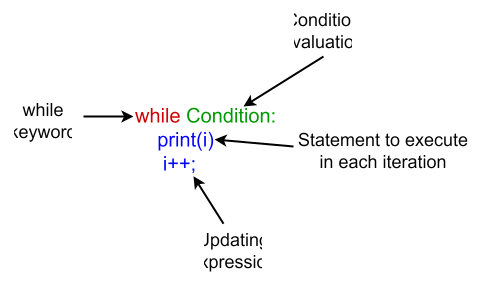 Image scaled to 60%
Explanation:
- condition: This is a boolean expression that determines whether the loop will execute again. If this condition evaluates to
True, the code block within the loop will be executed. Once the condition evaluates toFalse, the loop stops.
Execution Flow
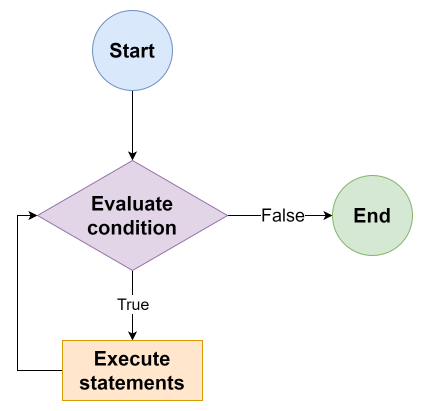 Image scaled to 50%
Example
Explanation:
count = 0: Initializes a counter variable to 0.while count < 5:: Starts a loop that will continue as long ascountis less than 5.print(f"Count is {count}"): Each loop iteration prints the current value ofcount.count += 1: Increasescountby 1 on each iteration, moving towards breaking the loop condition.
The while loop is a powerful tool in Python that allows for repetitive tasks to be performed with dynamic conditions. Understanding how to control the flow of a while loop is crucial for developing effective Python scripts that can handle varying runtime conditions efficiently. Whether you are looping a fixed number of times or indefinitely, the while loop provides the flexibility needed to achieve robust program behavior.